In 2026, the question isn’t just “do I need a fence?”—it’s whether you should dig a trench or connect to a satellite.
For decades, the “Invisible Fence” (a wired, in-ground system) was the gold standard. But in the last two years, GPS technology has advanced so rapidly that for many dog owners, burying a wire is becoming obsolete. However, GPS isn’t perfect for everyone.
If you are trying to decide between the reliability of a buried wire and the high-tech freedom of a GPS collar, this guide breaks down the pros, cons, and the real costs you’ll pay in 2026.
1. The GPS Wireless Fence: The 2026 Standard
Best for: Properties over 0.5 acres, oddly shaped lots, and frequent travelers.
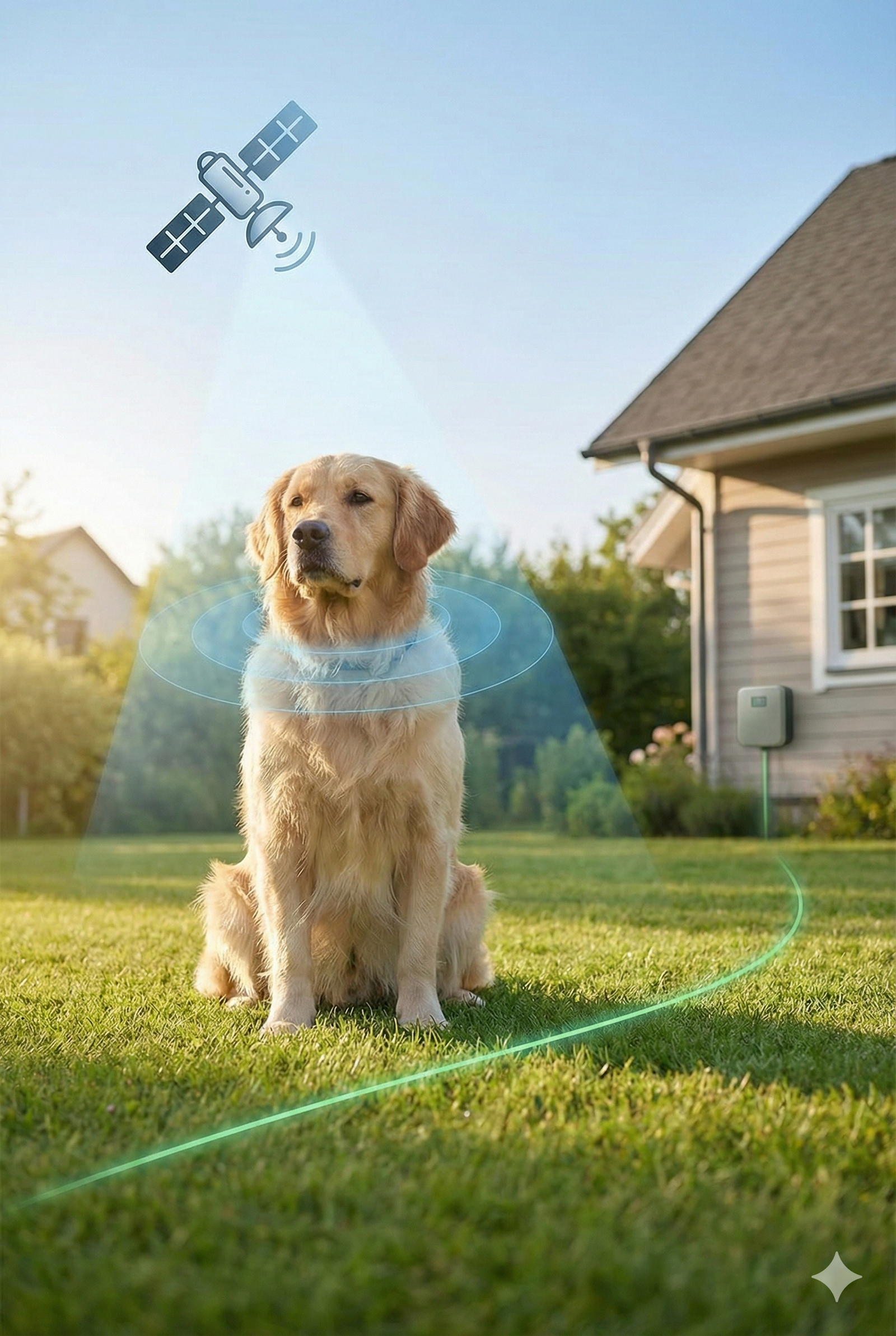
GPS fences (like Halo Collar 5 and SpotOn) use satellite data to create a virtual boundary. You simply walk the perimeter with the collar (or draw it on your phone), and the fence is set.
The Pros
- Zero Digging: You can fence 20 acres of dense woods or rocky terrain in under an hour.
- Portability: Going camping or visiting an Airbnb? You can create a new fence instantly.
- Smart Tracking: Unlike old systems, these collars don’t just contain; they track. If your dog escapes, you can see their real-time location on a map.
The Cons
- Accuracy Drift: While 2026 tech is better, GPS can still “drift” by 3–10 feet depending on cloud cover and trees. This makes it a bad choice for small suburban yards where a 5-foot drift puts your dog in the neighbor’s flowerbed.
- Battery Life: You have to charge the collar every night (or every other night). If you forget, you have no fence.
The Heavy Hitters
- SpotOn: The premium choice. It uses a dual-feed antenna that handles heavy tree cover better than any other system. Cost: High upfront (~$899), but no mandatory subscription.
- Halo Collar: The popular choice. Excellent training features by Cesar Millan. Cost: Lower upfront (~$549), but requires a monthly subscription ($10–$30) to function fully.


2. The In-Ground (Wired) Fence: The Reliable Classic
Best for: Small suburban yards (under 0.5 acres) and strict HOA boundaries.
This system involves burying a copper wire 3–6 inches underground around your property. It connects to a transmitter in your garage.
The Pros
- 100% Precision: The boundary is exact. If you set the line at the edge of the sidewalk, it stays there. It does not drift.
- Set It and Forget It: Most collars use replaceable batteries that last 3–6 months. You don’t need to remember to charge them nightly.
- Cheaper Long-Term: Once the wire is in the ground, there are no monthly fees.
The Cons
- Installation Nightmare: You (or a pro) must trench every inch of the boundary. Roots, driveways, and sidewalks are major obstacles.
- Wire Breaks: If a rodent chews the wire or you accidentally shovel through it, the entire system goes down, and finding the break can take hours.
3. Real Cost Breakdown (2026 Estimates)
Many owners look at the sticker price and forget the installation or subscription costs. Here is what you will actually pay over 3 years.
| Cost Factor | DIY Wired Kit | Professional Wired Install | GPS Fence (Subscription Model) | GPS Fence (No Subscription) |
| Upfront Hardware | $250 – $400 | $1,500 – $2,500 | $549 (Halo Collar 5) | $899 (SpotOn) |
| Installation | $0 (Your labor) | Included | $0 | $0 |
| 3-Year Subscription | $0 | $0 | $360 – $1,000 | $0 |
| 3-Year Battery Cost | ~$150 | ~$200 | $0 (Rechargeable) | $0 (Rechargeable) |
| Total 3-Year Cost | ~$400 – $550 | ~$1,700 – $2,700 | ~$1,000 – $1,600 | ~$1,000+ |
The Takeaway:
- Cheapest: DIY Wired (if you are willing to do the hard labor).
- Middle Ground: GPS Fences. They are cheaper than a professional wired install but more expensive than a DIY job.
- Most Expensive: Professional Wired Installation.
4. The “Hidden” Costs Nobody Tells You
Before you buy, consider these factors that don’t show up on the price tag:
1. The “Subscription Trap”
Many modern GPS fences are essentially “bricks” without a subscription. Brands like Halo require a monthly plan to enable GPS tracking and data storage. If you stop paying, your $600 collar loses its smartest features. Always check if the collar works offline (like SpotOn or the PetSafe Guardian) if you hate monthly bills.
2. The Multi-Dog Multiplier
With a wired system, adding a second dog is cheap—you just buy another receiver collar ($100–$150).
With a GPS system, adding a second dog means buying a whole second unit ($600–$1,000) and paying a second subscription fee. If you have 3+ dogs, GPS becomes significantly more expensive.
3. The “Tree Cover” Factor
If you live in a heavily wooded area (common in the Midwest or Northeast), cheap GPS collars will fail. You must invest in a system with “dual-band” or “active antenna” technology (like SpotOn). If you buy a budget GPS collar for a wooded lot, you will likely end up returning it.
Final Verdict: Which One Should You Buy?
Choose a GPS Fence (Halo/SpotOn) if:
- You have more than 0.75 acres.
- You have a complex property shape (creeks, heavy brush) where burying wire is impossible.
- You travel often and want a portable fence.
Choose an In-Ground Wired Fence if:
- You live in a standard suburban subdivision with neighbors close by.
- You have a small yard (under 0.5 acres) where GPS drift would be dangerous.
- You want a “set it and forget it” solution and know you will forget to charge a collar every night.