Category: Dog Safety / Vehicle Gear
If you wouldn’t let your child ride in the back seat without a seatbelt, why does your dog ride in a flimsy wire cage?
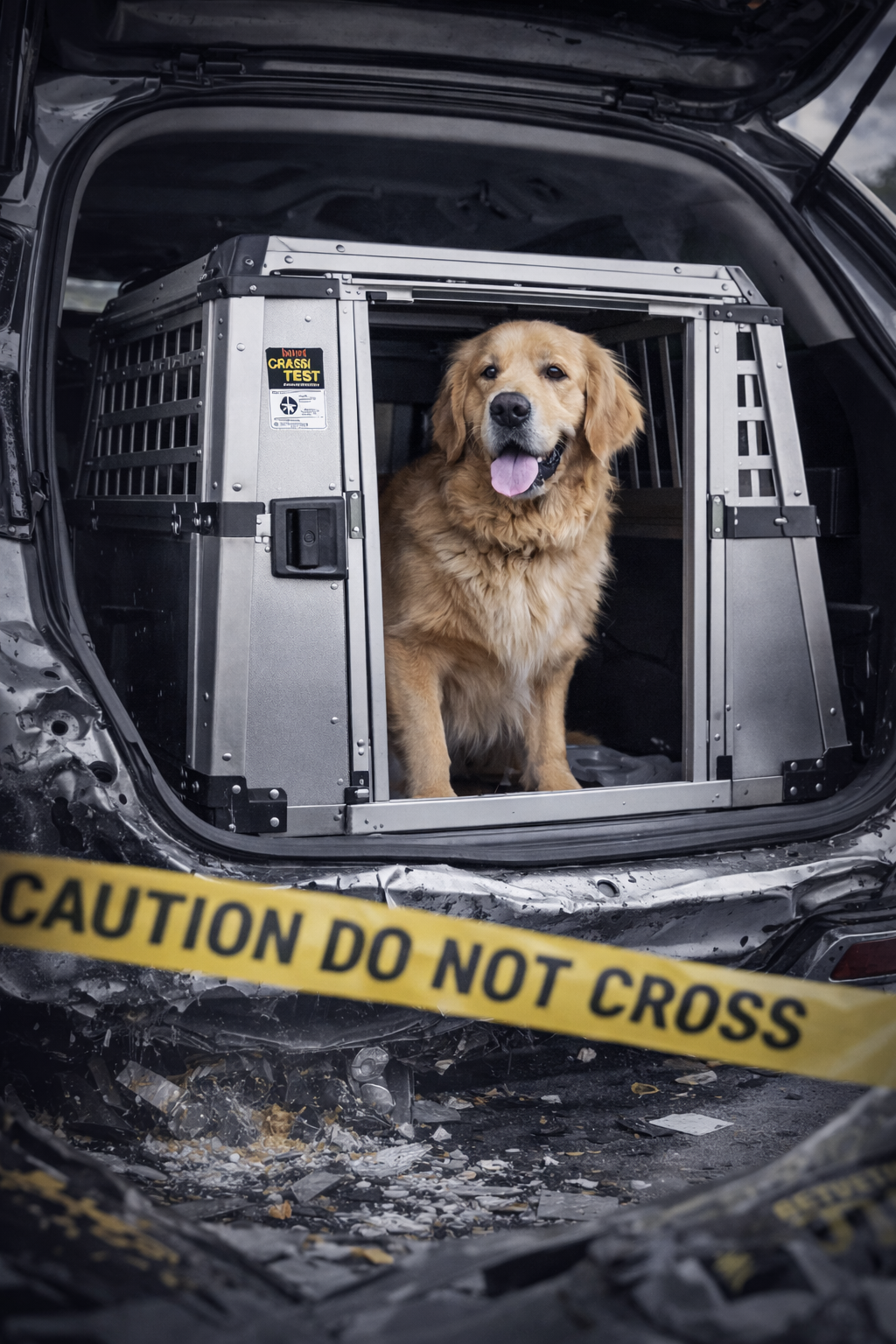
It is a harsh question, but in 2026, it is one that more pet owners are forcing themselves to answer. For decades, the standard wire “crate” was viewed as a safety device. In reality, in a collision of just 30 mph, a standard wire crate does not protect your dog—it often becomes the very thing that injures them. The wire welds snap, the plastic tray shatters, and the dog becomes a projectile.
This realization has birthed a new industry of “Crash-Tested” and “Impact-Resistant” dog crates. These aren’t just cages; they are engineered safety cells built with the same rotomolding technology used in whitewater kayaks or the heavy-gauge aluminum used in aerospace.
But there is a catch: The Price.
While a wire crate costs $50, these safety systems range from $400 to over $1,200. Is a dog crate really worth the price of a used laptop? Or is this just clever marketing preying on our fear?
This guide delves deep into the physics of crash safety, the materials that actually work, and the top crash-tested crates you can buy directly on Amazon in 2026.
1. The Physics of a Pet Crash
To understand why a $50 crate fails, you have to look at the math.
In a car accident, weight is multiplied by speed (G-force). A 60-pound Golden Retriever in a car traveling at 35 mph does not hit the back of your seat with 60 pounds of force. They hit with approximately 2,100 pounds of force.
The “Wire Crate” Failure Mode
Standard wire crates are designed for containment, not impact. They are held together by small spot welds. When that 2,100 pounds of force hits the front wall of a wire crate:
- Weld Shear: The welds snap instantly.
- Collapse: The structure folds inward, often crushing the dog.
- Projectile: If the door latch fails (which it usually does), the dog is ejected from the crate, becoming a danger to human passengers and themselves.
The “Plastic Carrier” Failure Mode
Standard two-piece plastic carriers (the kind held together by plastic wing-nuts) are better than wire, but they often fail at the seam. Upon impact, the top half separates from the bottom half, and the dog is ejected.
Crash-tested crates are designed to handle this G-force without structural failure. They keep the dog contained (preventing ejection) and maintain their shape (preventing crushing).
2. Material Science: Rotomolded vs. Aluminum vs. Steel
In 2026, high-end crates generally fall into three material categories. Understanding the difference is key to knowing what you are paying for.
Rotomolded Plastic (e.g., Lucky Duck)
- The Tech: This is the same manufacturing process used to make YETI coolers and whitewater kayaks. A heated mold is rotated until the plastic forms a single, continuous, double-walled shell.
- The Benefit: There are no seams to split. The plastic is incredibly tough but has a slight amount of “give,” which helps absorb energy in a crash.
- The Downside: They are heavy and bulky. The walls are thick, which reduces the interior space for the dog.
Heavy-Duty Aluminum (e.g., Impact)
- The Tech: Sheets of high-gauge aluminum are riveted or welded together.
- The Benefit: Strength-to-weight ratio. Aluminum is lighter than rotomolded plastic but incredibly strong. It also offers better ventilation (airflow) than plastic crates, which can get hot.
- The Downside: Aluminum is rigid. It doesn’t absorb energy as well as plastic; it resists it.
Steel with Crumple Zones
- The Tech: This is the most advanced approach. Instead of just being “hard,” these crates are designed to compress.
- The Benefit: Just like your car, the crate has “crumple zones.” In a rear-end collision, the crate compresses in a controlled manner to absorb the shock, protecting the dog’s spine and neck.
- The Downside: They are very heavy, expensive, and complicated to assemble.
3. The “Center for Pet Safety” (CPS) Explained
You will see the term “CPS Certified” or “5-Star Crash Test Rating” thrown around.
The Center for Pet Safety is a non-profit research organization that independently crash-tests pet products using realistic sled tests (similar to human auto safety tests).
The Standard: To pass a CPS test, the crate must:
- Keep the dog fully contained (no ejection).
- Remain anchored to the vehicle (straps must not break).
- Maintain structural integrity (cannot collapse on the dog).
- The door must remain closed but be openable after the crash.
Note: Not all crates listed below are CPS Certified, but they are all significantly engineered for safety beyond standard crates.
5. The 5-Star Fortress: Lucky Duck Kennel
Material: Double-Walled Rotomolded Plastic
Best For: Maximum safety in a “portable” format.
While Gunner Kennels often gets the glory, the Lucky Duck Kennel is the unsung hero of the crash-test world. It holds a 5-Star Crash Test Rating from the CPS and is available directly on Amazon.
Why It Is Worth the Money
- The Door: The weak point of most crates is the door latch. Lucky Duck uses an injection-molded reversible door with a heavy-duty locking paddle latch that looks like it belongs on a bank vault. It survived the CPS sled test without popping open.
- Lightweight(ish): Weighing around 38 lbs (Intermediate), it is lighter than a Gunner G1 (approx 50 lbs), making it easier to move if you switch cars often.
- Ventilation: It has excellent ventilation holes on the top and sides, angled to prevent rain from getting in while keeping air moving.

- CRASH TESTED – 5 star crash test rating, keeping your canine companion safe and secure. Patented design is durable yet l…
- INTERMEDIATE SIZE – designed for dogs up to 50 pounds. Dog crate interior dimensions – 30.25”L x 20.5”W x 22”H. Measurem…
- MADE in THE USA – lifetime warranty on this ingeniously designed dog kennel. Injection molded door features quick flip d…
The Trade-Offs
- Sizing: It runs slightly smaller than typical crates. Be sure to measure your dog carefully.
- Floor Shape: The floor has drain channels (great for cleaning), but you will need a thick pad to make it comfortable for sleeping.
Who Should Buy It: If you want CPS 5-Star safety but need to buy on Amazon, this is your winner.
6. The Aluminum Vault: Impact “High Anxiety” Crate
Material: Heavy-Duty Aluminum
Best For: Escape artists and dogs with severe separation anxiety.
If your dog destroys plastic or bends wire, the Impact High Anxiety Crate is the solution. While it is marketed heavily for “escape proofing,” its welded aluminum construction makes it incredibly safe for travel.
Why It Is Worth the Money
- The “Houdini” Proofing: The door features four separate latch points and a bar design that prevents dogs from getting their jaw around the bars to pull.
- Ventilation: This is the airiest crate on this list. If you live in a hot climate (Phoenix, Florida, Texas), the aluminum stays cooler than thick plastic, and the 360-degree airflow is superior.
- Space Efficient: Because the walls are thin aluminum rather than thick plastic, you get more interior room for the dog with a smaller exterior footprint.

- Impact Dog Crate’s Best Warranty – Backed by Impact Dog Crate’s 10-Year manufacturer dog damage warranty.
- Zinc Steel Paddle Latch – Zinc-plated steel paddle latch which provides a robust mechanism for added security against th…
- Four Additional Butterfly Latches – It features four additional butterfly latches, providing maximum strength and securi…
The Trade-Offs
- Rigidity: Aluminum does not absorb shock; it transfers it. In a crash, this crate will hold its shape perfectly, but the dog may feel more of the jolt compared to a “flexing” plastic crate.
- Price: This is often the most expensive option on the list.
Who Should Buy It: Owners of “destroyer” dogs who need a crate that doubles as an unbreakable home kennel and a travel safe.
8. The Modern Hybrid: Diggs Revol
Material: Reinforced Plastic & High-Grade Aluminum mesh
Best For: City dwellers and occasional travelers.
The Diggs Revol looks like it was designed by Apple. It is beautiful, collapsible, and innovative. While it is not a “heavy-duty” crate in the same league as a Variocage, it is vastly safer than standard wire crates.
Why It Is Worth the Money
- Collapsible: Unlike rotomolded crates which are huge solid blocks, the Revol collapses flat in seconds. If you live in an apartment or need to reclaim your trunk space for groceries, this is a game-changer.
- Diamond Mesh: Instead of standard wire, it uses a diamond-shaped aluminum mesh that is incredibly difficult for a dog to push through or get a paw stuck in.
- Garage Door: It has a side “garage door” that opens fully, making it feel open and airy for the dog.
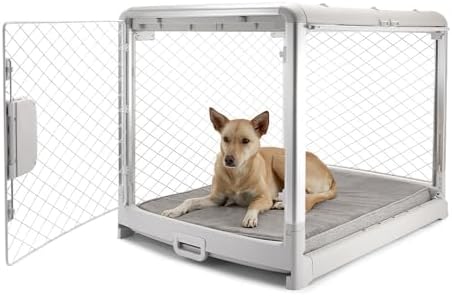
- AWARD-WINNING PREMIUM CRATE: Revol is our ultimate collapsible dog crate offering superior design with uncompromising sa…
- IS THIS THE RIGHT SIZE FOR MY DOG?: Ideal for dogs up to 20”-26″ tall, or 50-70lbs, such as Border Collies, Chow Chows, …
- FOLD AND STORE IN SECONDS: Patented design sets up in under 60 seconds with just one hand (note – “with just one hand” c…
The Trade-Offs
- Not for High-Speed Impact: While Diggs does crash testing, this crate is not designed for the same violent forces as a rotomolded crate. It is a “safer” crate, not a “survival” crate for highway speeds.
- Price: You are paying for the design and collapsibility, not just raw strength.
Who Should Buy It: Urban owners who need a crate that looks great in the living room and folds down for the occasional Uber or rental car trip.
9. The Budget Baseline: Petmate Sky Kennel
Material: Hard Plastic (Two-Piece)
Best For: Flying and budget-conscious safety.
If $600 is simply out of the budget, the Petmate Sky Kennel (or Vari Kennel Ultra) is the minimum acceptable standard for vehicle safety.
Why It Is Worth the Money
- Thick Plastic: The plastic used in the Sky Kennel is significantly thicker and more brittle-resistant than standard “pet store” carriers.
- 4-Way Vault Door: The door latches at the top, bottom, and sides (on larger models), making it much harder for a dog to bust out upon impact.
- Airline Approved: This is the standard crate for cargo air travel, meaning it is designed to withstand the rigors of baggage handling (which can be as rough as a minor car crash).

- FIRST-CLASS COMFORT FOR PETS: The Petmate Sky Kennel meets IATA requirements for live animal transport and meets most ai…
- EASY TRAVEL PREPARATION: The Sky Kennel is a travel dog crate that comes with essentials including two ‘LIVE ANIMAL’ sti…
- SPACIOUS INTERIOR FOR LARGE DOGS: Ideal for German Shepherds and breeds weighing 90-125 pounds, this dog kennel offers e…
The Upgrade Trick
To make a Sky Kennel safer for a car, zip-tie the corners. The weak point is the bolts holding the top and bottom together. Replace or supplement the metal bolts with heavy-duty zip ties at every available hole to prevent the shell from splitting open in a crash.
10. Critical Step: How to Secure the Crate
Buying the crate is only half the battle. If you put a $1,000 Variocage in your trunk and don’t strap it down, it is just a $1,000 projectile.
You MUST Strap It Down.
In a crash, an unsecured crate will fly forward, crushing the rear seats.
- Use the Cargo Hooks: Locate the metal “D-rings” in the floor of your trunk or SUV cargo area.
- Buy Rated Straps: Do not use bungee cords. Bungee cords stretch and snap. You need Ratchet Straps or Cam Buckle Straps rated for at least 500 lbs.
- The “X” Pattern: If possible, cross the straps over the crate or through the designated tie-down pins (Lucky Duck and Ruff Land have these built-in).
- Connection: Connect the crate directly to the vehicle’s frame (the floor hooks). Do not attach it to the rear headrests; they will snap off.
The Bottom Line:
Any of the crates on this list are a massive upgrade over a wire cage. Investing $600 today is painful, but orthopedic surgery for a dog with a broken pelvis starts at $5,000—and the grief of losing them is immeasurable. Drive safe.